

I sit with people who are dying, and with the people who love them, and the most common thing I witness is not grief. It is paralysis. A son stands in a doorway for ten minutes and then leaves without going in. A wife of fifty years talks about the weather because everything else feels too large.
The fear underneath is that saying the wrong thing will cause harm. In my experience, almost nothing said with affection causes harm. Absence does.
You do not have to be profound
There is a myth that the deathbed requires eloquence. It does not. Presence is the thing being asked for, and presence is mostly ordinary. Tell them what the traffic was like. Report the score. Read the newspaper aloud. Bring the dog.
A patient once told me that his favorite part of the week was his neighbor coming over to complain about the neighbor’s own knee surgery. It was the only conversation in which he was still a person rather than a patient.
Four sentences that carry a lot
Palliative physicians often teach a version of this and it holds up: Thank you. I forgive you. Please forgive me. I love you.
They can be said in any order, more than once, or in whatever plainer words fit your family. They cover most of what tends to go unsaid, and families who manage to say them almost always tell me afterward that it was the part they were most glad of.
A fifth is worth adding: Goodbye. It is the hardest, and its absence is the most frequently regretted.
Ask rather than reassure
When someone says I think I am dying, the instinct is to answer don’t say that. That response, meant kindly, closes a door the person just worked up the courage to open.
Better: What makes you feel that way? Or simply: Tell me more. You are not obligated to have answers. You are only being asked to stay in the room while they say the thing out loud.
The same applies to fear, to anger, and to the question of whether any of it was worth it. These are not problems to be solved. They are things to be witnessed.
Silence is allowed
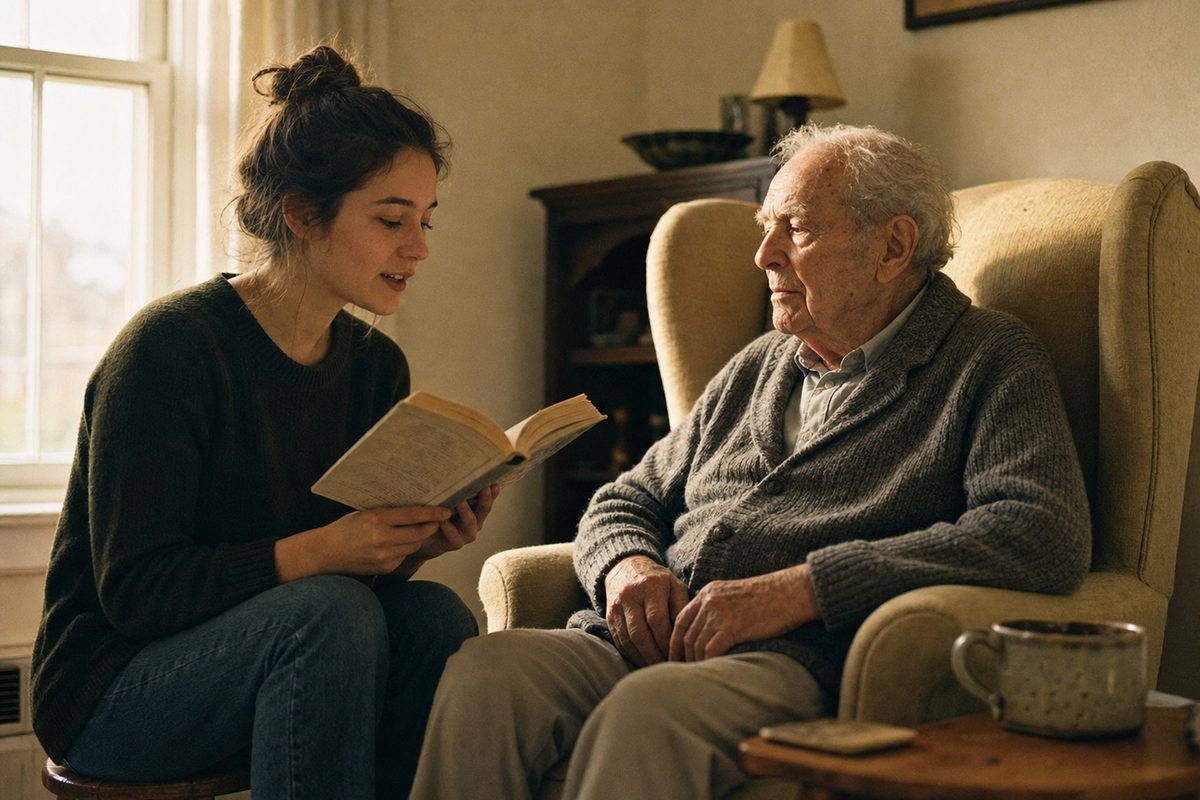
Some of the best visits I have seen involved no conversation at all — a daughter doing a crossword in the chair, a grandson watching a game with the volume low. Being in the room is a message in itself, and for someone who is very tired, it may be the only message they have the energy to receive.
Touch communicates when words are gone. A hand, a shoulder, a cool cloth on the forehead. Hearing appears to persist to the very end, so keep speaking even when there is no response — say who you are as you come in, and say what you came to say.
Children should be allowed in
Parents often shield children from a dying grandparent and regret it later. Children generally do better with the truth, told simply and in the right size, than with a mystery they can feel but not name. Use real words — died, dying — rather than passed away or went to sleep, which can frighten a small child more than the fact does.
Let them decide how close they want to get, and let them leave when they want to leave. Our social worker helps families think this through, and it is one of the more common things we are asked about.
On your own guilt
Nearly everyone thinks they got something wrong: waited too long, said too little, was not there at the moment. Almost none of it is true in the way it feels.
If you visited, you did the thing that mattered. If you sat quietly and said nothing memorable, you were still there, and being there is what will be remembered by everyone who was in the room, including, we have every reason to believe, the person in the bed.